

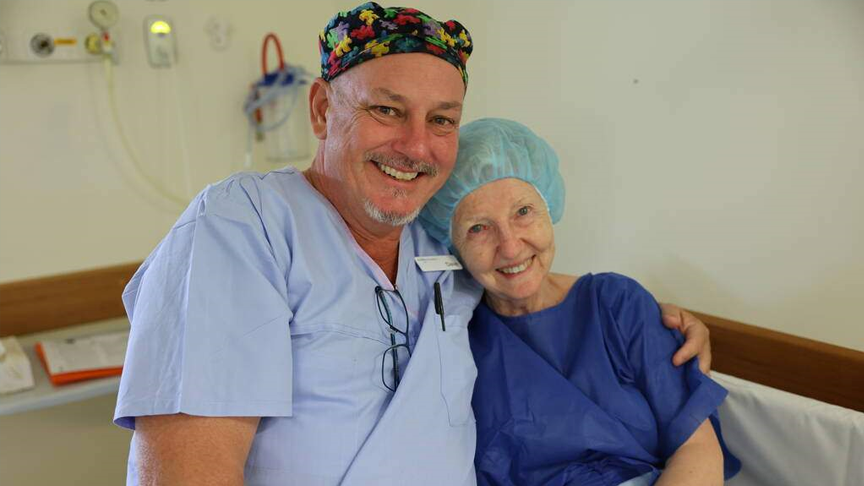
Sunshine Coast Health patients diagnosed with skin cancers on or near their eyelids can now access a new type ofprecision surgery, that reduces the risk of recurrence while preserving as much of the eyelid as possible.
Known as the ‘skin cancer capital of the world’, the Sunshine Coast is now home to Queensland’s first publicly funded Mohs surgery clinic and Australia’s first dedicated Mohs and oculoplastic unit.
Mohs surgery is a precise, staged technique for removing skin cancers, which involves thin layers of tissue being removed and examined in real time, continuing until no cancer cells remain.
Sunshine Coast Health Ophthalmologist specialised in Ocular Plastic Surgery Dr Ebony Smith said this ensures complete tumour removal, while sparing as much healthy tissue as possible.
“When you normally cut out a skin cancer you have to take out a safety margin around that skin cancer to make sure you’ve got the whole thing, but Mohs surgery means you can cut right near the skin cancer, leaving the healthy tissue behind,” Dr Smith explained.
“And you examine it under the microscope in a different way so you can see that you have the whole cancer,” she said.
Importantly, this technique significantly reduces the chance of recurrence, as it looks at the whole margin.
“Around the orbit, if the cancers aren’t cut out completely or they come back, you’ve got more of a chance of them metastasising, moving into the orbit which can cause you to lose vision, or further back into the brain which can be palliative,” Dr Smith said.
Sunshine Coast Health Dermatologist specialising in Mohs surgery Dr Jazlyn Read said there are also cosmetic and functional benefits to minimising the amount of tissue removed.
“To preserve each millimetre around the eye means you’re keeping more of your native eyelid, we can also try to preserve really important structures like the lacrimal apparatus which drains the tears, which has a really functional effect as well as being a really cosmetically sensitive area,” Dr Read said.
The real time testing in this new approach allows patients to have the whole process done in one day – rather than going home to wait for results, and then returning for further surgery.
“So if you think about our first patient, who is a nurse from Gympie, that’s her travelling all the way to Gympie two, three times more than what she does if we just get it all done today,” Dr Smith said.
While eyelid skin cancers aren’t as common as in other parts of the body, the team are expecting many patients to benefit from this surgery.
“Most of the skin cancers we see around the eye are about cumulative sun damage and living somewhere like South East Queensland there’s obviously a lot of sun and it’s also an area where it’s very difficult to apply sunscreen,” Dermatologist Dr Read said.
Caloundra Health Service Director of Nursing Amy Carey said the surgical team is proud to offer this unique collaborative service for locals.
“We want to say a really big thank you to the Caloundra Hospital Auxiliary for being huge supporters of this service and providing us the new equipment for this surgery.”
Lyn’s story
Lyn Carr is thrilled to have been one of the first patients to be treated with Mohs at Caloundra Health Service.
She was surprised when what she originally thought was an ulcer on her lower eyelid, turned out to be a basal cell carcinoma (BCC).
“I’ve been lucky with my eyes all through my life,” Lyn said.
In fact she’s always particularly loved her blue eyes, since she first met her husband at 17.
“When he said ‘can I see you again’, I think one of the first things he said to me was ‘I loved your eyes’,” she remembered.
Lyn was excited to be able to access Mohs surgery and relieved to know only the minimal amount of tissue would be removed, while also reducing the chance of any cancer coming back.
“I just feel full of confidence, I really do."